
When scientist Michele Daly experienced disturbed vision in August last year, she visited her optometrist promptly. Unfortunately, it wasn’t until February 2025 that the source of the ‘floaters and flashing lights’ in her right eye was diagnosed at Auckland’s Greenlane Eye Clinic. An initially suspected retinal detachment was, in fact, a rare, aggressive cancer known as ocular melanoma.
“I was shocked,” says Michele. “I didn’t really know what having an eye tumour meant, but I sensed that it was serious and likely to be malignant.”
Blood tests for liver functioning and a consultation with an ophthalmologist followed.
“The ophthalmologist suspected I had a large ocular choroidal melanoma. He took me through different treatment options, which all sounded invasive – and recommended removing my eye. He also warned that my cancer could spread quickly, to my liver, lungs and bones.”
Fortunately, scans confirmed that the cancer had not yet spread. After considering all of the options she was presented with, Michele decided to have her eye removed. It was the quickest way to remove the tumour, and she had good sight in her remaining eye.
I decided I just wanted this tumour gone. It meant losing my eye, but people adapt, and I could adapt too. What I didn’t want was for the tumour to send out seeds to the rest of my body.”
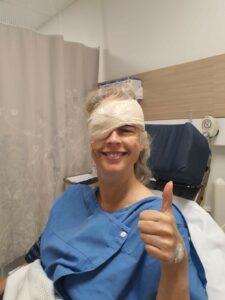
Michele after her eye surgery
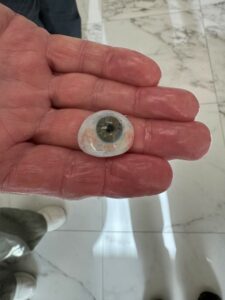
Michele’s prosthetic eye
Surgery went smoothly and Michele healed well over the next few months. Adapting to her new situation was challenging, however.
“I lost a lot of confidence. I had very limited depth perception as my brain adjusted to the different signals. I was also advised not to drive for three months due to this adjustment period, and even walking was hard at first. If you’ve got singular vision, you’re at greater risk of trips and falls. And I had to wear glasses for the first time in years.”
Before she received her prosthetic eye, Michele found participating in work meetings difficult.
“I had to explain the eye patch. What do I tell people? How will they react? It was emotionally draining.”
Then there’s the grief. “I felt huge grief losing my eye. But it was the prospect of the cancer spreading that caused the most fear and anxiety. Things can be a struggle. I have my days, that’s for sure.”
Unfortunately, the tumour histology has confirmed a high-risk tumour. “I’ve been given an over 70% chance that it will spread in the next one to three years.”
Counselling is helping. So too is a strong support network, a good clinical team (including an oncologist), and self-care that includes exercise, meditation and ‘integrated treatments’ like naturopathy to boost her immune system. Cutting her working hours has reduced Michele’s stress – and her income too.
There’s a sense of being in limbo.
This is a stage 3 melanoma and there’s nothing they can do. With most cancers, there’s surgery, then chemotherapy, radiotherapy – a toolkit of drugs to try to mop up rogue cells and prevent them spreading. But the drugs for skin melanoma don’t work on eyes. There’s no treatment for ocular melanoma until the tumour spreads. Then it’s palliative care as it’s not curable”.

Michele with her new prosthetic eye
“So, it’s now about surveillance. I’m on three-monthly scans, X-rays and blood tests.”
Despite the challenges, Michele remains positive. “Don’t let the fear of the future ruin the joy of the present – that’s my mantra.”
She welcomes more research and would like to see ocular melanoma ‘on every optometrist’s radar’. You can get cancer in any part of your body, so why not the eye?”
For more information about ocular melanoma and how to help prevent and detect it early, click here.