
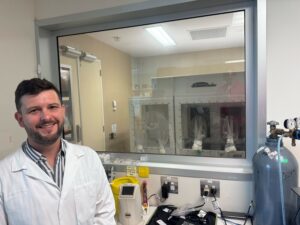
We had a quick catch up with Dr Verdon about his current melanoma research project, “Clinical-Grade Development of Personalised T-Cell Immunotherapy for Melanoma“, and here’s what he had to say…
Q: What inspired you to focus your research on melanoma?
A: “I’ve always been fascinated by the interaction between the immune system and cancer, and melanoma is also part of my family history. It’s a cancer that occurs at unusually high frequency in New Zealand and one where cell-based immunotherapy has clear potential to have a major impact on patients’ lives.”
Q: What’s the most exciting or surprising thing you’ve discovered so far in your melanoma research?
A: “One of the most exciting things has been seeing that we can generate cancer-targeting immune cells directly from a patient’s blood, without needing to extract them from tumour biopsies. We’ve also found that by carefully controlling the signals we give these cells as we grow them, we can programme how well they kill, survive, and move through the body, making them more effective against cancer.”
Q: In one sentence, how would you explain your melanoma research to someone who doesn’t have a science background?
A: “We identify the best “targets” in a patient’s tumour and train their own specialised “killer” immune cells to recognise and attack them, so they can both attack the cancer and provide long-lasting protection against it coming back.”
Q: How could your research change the way melanoma is detected or treated in the future?
A: “In New Zealand we don’t currently use cell-based immunotherapies for melanoma, even though new treatments like checkpoint blockade inhibitors rely on the immune system to work. Our research could provide a new approach to personalised immune therapy, improving response rates and working synergistically in combination with treatments like checkpoint blockade and cancer vaccines.”
Q: What’s one thing you wish more people understood about melanoma?
A: “People may not realise that T cells in our immune system can kill cancer, but only if they can ‘see’ the cancer as different from normal healthy cells (like they do for a virus). In melanoma, UV damage causes DNA mutations and creates abnormal proteins that T cells can recognise, but the complicated process of generating an effective T cell response only occurs in some patients. What’s exciting now is that because we understand the signals that drive the growth of these anti-cancer T cells, we can build that response outside the body for any patient and give it back as a personalised immune therapy, rather than just hoping it happens on its own.“