
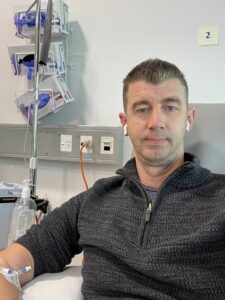
Martin describes his life as “pretty average” until 2019. He was married with one son, living in their family home in Auckland, excelling in his engineering career, and generally living a healthy lifestyle.
“There was no history of skin cancer in my family. I’d had the odd sunburn growing up, but nothing that stood out, and nothing to an alarming degree. I was never a ‘shirt off’ kind of guy, and I knew it was important to cover up in the sun,” says Martin.
But one day when Martin was having some tattoo work done on his upper right back, his wife noticed an unusual mole, which prompted him to get it checked by his GP.
“The mole had been bleeding through my t-shirts off and on for about a week and had scabbed over. It was firm, raised, crusty, and small. I thought it was a harmless spot of some sort or that I’d caught it on something.”
Martin’s GP looked at it and agreed it was concerning, so a biopsy was done there and then.
“I wasn’t exactly sweating over the results, but I was curious to know what it was. When the GP called me and said the results showed it was melanoma stage 1B, I instantly knew it was serious,” says Martin.
Shortly after, Martin had a wide excision, followed by 18 months of regular skin checks and multiple other moles removed, which were all precautionary.
It was during one of those routine check-ups when he pointed out a lump had appeared where the original mole had been. Martin was immediately sent for a needle biopsy and a PET-CT scan, which confirmed that Martin’s melanoma had progressed to stage 3. Once again, Martin had another wide excision on his upper right back and shoulder.
“This is when I knew melanoma was really going to test me, and I had to ask myself if I was up for the challenge,” he says.
Martin decided from then on to move quickly, trust the professionals, and try to keep a normal routine as he underwent a range of treatments.
From 2019 to 2023, Martin had further surgery, said ‘yes’ to taking part in an immunotherapy trial, had more scans, leading to the discovery that the cancer had spread through his lymph nodes.
Martin’s medical team advised him to act quickly before it progressed to stage 4, so Martin had more surgery and began his treatment of privately funded inhibitors and radiation therapy.
“I remember in March 2023 finally getting some good results – my scans were clear. I started to feel more optimistic and was able to see a future,” says Martin.
But as 2023 went on, he received his first stage 4 diagnosis. Scans revealed that Martin’s melanoma had spread to his liver and his upper spine. Martin started a new course of privately funded inhibitors, but this time set up a Givealittle page to try to fundraise for the medicines and managed to raise $30,000 in three weeks (out of the $50,000 he needed).
“I knew what I had to do to keep fighting it. I’ve always been mentally resilient. During my cancer journey, I’ve had sessions with a psychologist once every month or two up until 2025. The psychologist helped put context around things that I needed help with. I think psychological support is always valuable, even for those who feel mentally tough,” says Martin.
Follow up scans showed no active signs of disease on his liver and spine, but it was now on his right lung. Despite this, Martin never gave up and kept taking the advice of his medical team, support and love from his family and friends, and he continued his treatment. His next scan showed a 100% reduction, which was incredible news for both Martin and his family.
Martin ended his treatment around November last year, but a follow-up PET CT scan showed some very small hotspots on the surface of his brain, and in essence, stage 4 has now returned for a third time. Martin’s medical team worked quickly to get him back onto treatment, which he is currently undertaking and will be for the next two years.
Martin is now trying to reconcile everything that has happened. Although he continues to face ongoing health challenges, his powerful mindset and inner strength, not to mention the support from his wife, son, extended family and team of medical experts – “they all help me continue on my journey and empower me to keep going and to keep dealing with whatever comes next.”
“I will not give in to cancer,” says Martin. “I’m at peace with whatever comes my way next, and I will continue to fight it head-on.”
We wish Martin all the best with his ongoing treatment and will continue to follow his journey.
Martin’s advice for others navigating a melanoma diagnosis
Martin acknowledges that everyone has a different journey, different medications, and a different approach. But here are some tools that worked for him over his seven-year melanoma journey, which he thought may be helpful to others.
Speak about it with others
When you feel able to, it’s good to start speaking about your diagnosis and what you’re going through. You can start with members of your family, and eventually tell your friends when you’re ready. If someone asks how you’re doing, try not to be afraid to tell them – they want to listen to you, and you can lean on them for support.
Let your employer know
A diagnosis often can mean attending lots of appointments, and quite often, last-minute ones. Try to let your employer know as soon as you feel comfortable to do so – you can still show commitment but put your health first.
Try counselling
It may be something you don’t initially feel like trying, but when you finally do, it is very helpful – especially for particularly challenging times or things you find hard to get past or accept.
Trust the professionals
Take all the advice you can get – from the professionals, not Dr Google. Never leave your consultant’s room without a plan. Trust the people to do their job properly, and don’t be scared to ask questions.
Rest whenever you can
When you’re going through treatment, the tiredness can feel different, or it may be difficult to sleep. Get as much rest as possible. When you’re tired, put your head down and try to accept this as temporary.
Get away from day-to-day life
This doesn’t necessarily mean going on holiday. Go for a walk, visit friends or family, go to the cinema or go out for dinner. If you’re able to, find distractions and things to look forward to. It’s important not to let your diagnosis consume you and to try to maintain normality where possible. Your mind is not always your friend.
Melanoma New Zealand support and resources
Get support
Our skilled nurses and counsellors are here to help you. If you live in New Zealand and you or a whānau member are concerned about a possible melanoma or are dealing with a diagnosis of melanoma, please get in touch.
- Book a nurse appointment
- Book a patient counselling appointment
- Book a carer, family or whānau counselling appointment
- Register your interest in one of our support groups
Useful resources
If you need more information about melanoma and what to expect, please see the selection of booklets, guides and links below.
Additional resources are available here.
What to look for
Melanomas can often be detected using the ABCDEFG system shown on this page, although not all melanoma lesions show these characteristics.
Martin’s symptoms of bleeding, crusting, scabbing, or a small spot that won’t heal, can also be warning signs of melanoma.
It’s important to note that not all melanomas present with every A-G feature and that any changing, unusual, bleeding, or non-healing spot should be checked by your GP, skin specialist or dermatologist.